
I’m sat here listening to Marilyn Manson – The Reflecting God as I write this (through the Divine) and he talks about Hell and Heaven, or as I like to call them, Diablo and Divine. I’ve spent a good two weeks with these IEM’s, switching between them a lot, and my favourite changing constantly. There is one thing that holds true, if you’re after a planar IEM one of these should be what you’re reaching for, there is no reason to spend more. I own others, I’ve tried ones that are significantly more expensive, don’t waste your money, I’m confident that you’ll be very happy with one of these.=
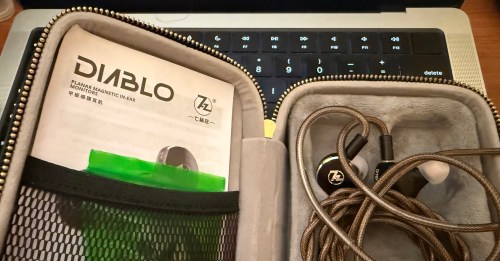
They come in the same packaging, one saying Diablo, and one Divine, both containing a very spacious case with the IEM (Black for Diablo, Silver for Divine), two sets of tips, a decent cable, and a manual. Nothing to complain about at all, and the cable has held up well. I would have liked a 4.4mm termination on the cable but I’m not going to complain at this price point.
I used my AK SP4000 for the majority of my listening time, volume was up around 70 on normal gain. They also both came travelling with me as I was away for work, so I had a decent amount of uninterrupted listening on planes and they isolate decently once you have a good seal.
Music wise I’ve been on a Nine Inch Nails, and Marilyn Manson binge so I listed to a lot of that. Jason Molina, Silversun Pickups, Lana Del Rey, and some classical also featured heavily. I wasn’t quite sure how to compare these so I’ve done a little write-up on both, some comparisons in the usual sections (but shorter), and then some track comparisons.
Divine: The Polite, Balanced One

The Divine feels like 7Hz and Crinacle trying to answer the question: “What would a planar sound like if it behaved itself perfectly?”
It’s a clean, neutral-with-a-dash-of-bass tuning, enough weight to avoid thinness, but still prioritising clarity, separation, and vocal presence. There’s a slightly forward upper-mid/low-treble push that gives singers articulation and air without tipping into shouty or glary. If anything, it toes a line between being nicely present and occasionally a touch “bitey” depending on the track, though never to a fatiguing extent.
Bass is tight, controlled, and quick, more about texture than slam. Sub-bass reaches, but it’s not the type that rumbles your jaw. People wanting warmth or big macro-dynamics might feel underwhelmed, but if you value accuracy over weight, it’s a very satisfying presentation. In fact, satisfying is probably the word for this IEM overall.
What stood out most to me was how sorted the Divine feels. Everything is tidy, nothing bloated, nothing exaggerated. It’s the kind of tuning that makes you lean in rather than sink back. For slower pop, R&B, vocal-centric music, and anything where you want the midrange front and centre, it feels extremely well judged.
Technically, it’s a proper planar: fast transients, snappy edges, and an almost invisible noise floor. Soundstage isn’t massive, but imaging is tight and well-drawn, especially with live recordings. Plenty of detail to go around. Extremely satisfying. As I mentioned earlier I’m listening to them while I write this, Florence and the Machine – Howl is currently playing, and it just sounds beautiful and satisfying, with her vocals near perfection.
Diablo: The Basshead Planar With Teeth

Switching to the Diablo after the Divine is… jarring, in a fun way. It’s big. It’s bold. It’s blatantly tuned for impact and it delivers.
Bass takes centre stage here: a significant lift in both mid-bass and sub-bass, almost 12 dB according to the specs, and it sounds like every bit of that. There’s real slam here, the kind of low-end you feel. The planar speed means it never devolves into a mushy mess, but it definitely dominates the stage.
This tuning pushes vocals back slightly compared to the Divine, giving the Diablo a thicker, darker, more atmospheric feel – I enjoyed it for the most part, think late-night energy. It’s not veiled so much as intentionally set further from the spotlight. Treble is smooth and rounded off, no sparkle monster here but it works for the tuning.
Where Divine is polite, Diablo is unapologetically rowdy.
Where Divine leans into clarity, Diablo leans into fun.
And where Divine shows off its technical chops calmly, Diablo hides its own behind a curtain of bass but it’s still there if you listen. The imaging, layering, and separation remain surprisingly clean once your ears acclimatise to the bass.
Anything that needs drive, weight, and energy just clicks with the Diablo. Where the Divine is satisfying, the Diablo is impactful, demanding your attention.
Sound Comparisons: Two Sides of the Same Coin
Tuning
Divine: Neutral with a tasteful bass lift. Clean, articulate, vocal-forward.
Diablo: Deep V-shape. Heavy low-end, relaxed mids, smooth treble.
Bass
Divine: Tight, quick, controlled; quality over quantity.
Diablo: Huge, physical, room-filling; borderline subwoofer behaviour in an IEM shell.
Mids
Divine: Clear, present, intimate.
Diablo: Recessed, darker, more atmospheric.
Treble
Divine: Crisp and lightly emphasised with detail.
Diablo: Soft-edged, non-fatiguing with warmth.
Technicalities
Divine: The better “listener’s IEM”. More detail retrieval, more micro-information, better layering.
Diablo: Surprisingly competent but overshadowed by its tuning; still fast and coherent.
Fatigue & Long Listening
Divine: Can get a bit upper-mid forward at times, but generally easygoing.
Diablo: No treble fatigue, though the bass can be overwhelming on long sessions if you’re sensitive.
Track Comparisons:
Florence and the Machine – Howl
Divine – Everything is balanced extremely well, her vocals sound amazing on this one
Diablo – Similar detail at the start until the drum kicks in, one the drum arrive you have it banging in your head. Her vocals have a similar quality but the drum can mask some of the beauty of the track.
This one goes to Divine
Marilyn Manson – The Reflecting God
Divine – Once again very balanced, bass has decent impact, vocals are presented well, very coherent.
Diablo – The extra bass helps here and increases the enjoyment of the track. Retains the coherency, but a big plus on the fun factor. It goes from sounding great on the Divine to amazing on the Diablo. I would rank how the Diablo plays this as one of the my favourites at any price point.
This one goes to Diablo
Songs: Ohio – Just be simple
Divine – This track sounds how it should on the Divine, Jason’s vocals are front and centre, filled with all the emotion that he put into the recording. Beautiful.
Diablo – While there isn’t much bass on the track it is a little elevated and takes just a little something away. Still beautiful, and if I wasn’t A/B’ing I probably wouldn’t have noticed it, but it’s not quite as good.
This one goes to the Divine by a tiny margin
Linkin Park – Two Faced
Divine – Extremely detailed and coherent. Missing a little bit of excitement.
Diablo – Detailed, coherent, and fun. The excitement is injected back in with the elevated bass
This one goes to the Diablo
Which One Should You Get?:
Honestly, it’s less about which one is better and more about what you want from your music.
Choose the Divine if you want:
- Clean, balanced planar tuning
- Forward, expressive vocals
- Detail without harshness
- A calmer, more reference-leaning sound
- Something that works across many genres
Choose the Diablo if you want:
- A real bass experience
- A darker, moodier presentation
- Fun
- An IEM that you feel in the bass
- A specialist for energetic or bass-driven genres
At the end of the day I highly recommend both

Overall:
The Divine is the one I reach for when I want to hear the music.
The Diablo is the one I reach for when I want to feel it.
And because they’re priced relatively sensibly for planar IEMs, they end up complementing each other really well. They’re a fascinating pair to experience together and if your wallet permits, that would be my recommendation. Otherwise hopefully your choice should be obvious. While I’ve flip flopped a bit, the Diablo would be my favourite of the two, the Divine is a more normal planar experience at a very compelling price point, the Diablo delivers a basshead experience in a planar, which makes it just that little more interesting in my collection.
Diablo at $149:
| Category | Score | Notes |
|---|---|---|
| Bass | 4.8/5 | Huge, physical, immersive; nearly subwoofer-like for a planar. |
| Mids | 3.9/5 | Slightly recessed and darker; atmospheric rather than forward. |
| Treble | 3.9/5 | Smooth, rounded, fatigue-free; matches the dark, fun tuning. |
| Technicalities | 4/5 | Detail is strong, imaging holds up well once you adjust to the bass. |
| Build/Design | 4.5/5 | Perfectly fine. Would have liked a 4.4mm cable |
| Value | 5/5 | A truly unique planar bass experience at its price point. |
| Overall | 4.5/5 | A great basshead IEM. |
Divine at $149:
| Category | Score | Notes |
|---|---|---|
| Bass | 4/5 | Tight, controlled, textured; more about accuracy than impact. |
| Mids | 4.5/5 | Clear, present, intimate; vocals consistently shine. |
| Treble | 4.2/5 | Crisp, clean, lightly energetic; occasionally a touch “bitey” but never harsh. |
| Technicalities | 4.2/5 | Fast, resolving, tidy; excellent separation and layering. |
| Build/Design | 4.5/5 | Perfectly fine. Would have liked a 4.4mm cable |
| Value | 4.5/5 | A superb all-rounder that competes with more expensive planars. |
| Overall | 4.5/5 | A great allrounder IEM. |
 Aussie Audiophile
Leave a comment