
I generally get IEM’s to review so when Linsoul reached out to see if I’d like to review their new collaboration for a portable music player I jumped at the opportunity. I review items so people can hopefully find the right piece of equipment for them. My opinions are all my own and aren’t influenced at all. My ears are different to everyone else’s. Thanks to Linsoul for providing me with the device!
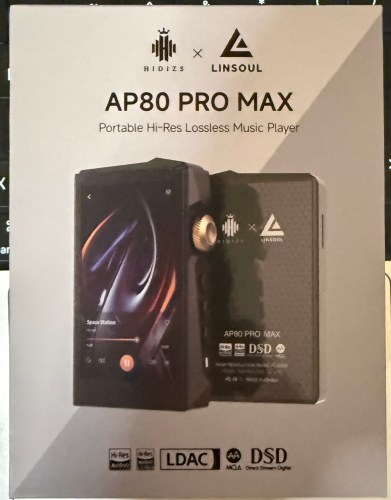
I’ve had the AP80 Pro Max for around three weeks to review, during that time I’ve tried to use it as my main music player (which to be honest was a little hard as I just got the AK SP4000 and want to give that a really good listen, but I persisted with it for the review). All up I would have had over 100 hours using the device.

A little on the packaging, it comes in a little box with the device, warranty card, instructions, USB C to C cable (to use it as an external DAC/AMP), a USB A to C cable for charging, and a spare set of screen protectors. Linsoul also provided me with a case, which is very nice, but does have an additional cost (I would recommend it!).
The device itself is pretty tiny, but the screen size works well (2.95inches). The volume wheel feels nice and is easy to find if you have the device in your pocket. It has a Play, Back, and Forward button below the wheel. On the bottom you have a USB C port, 3.5mm unbalanced, and 4.4mm balanced outputs. On the other side there is a MicroSD slot which takes up to a 2tb(!) card.
Some shots:


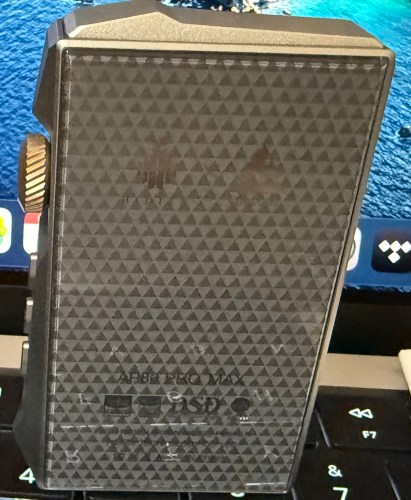


It also feels like quite a premium device, the body is made of aluminium with glass front and back. Front and back comes pre-installed with screen protectors. It weighs next to nothing (81g).
Before I get into how this works and how it sounds a little about me; I have a large variety of DAPS and Dongles, ranging from FiiO and iBasso dongles, the HiBy R4 and some earlier, smaller Walkmans, through to the AK SP4000, LP E7 / P6P, and quite a few others. I used the ZiiGaat Odyssey 2 (review for this incoming soon too) as my main IEM to allow me to try out the different sound options etc. but also tried it out with a range of IEM’s from my collection and it didn’t have an issue driving any of them. I briefly tried it with some fullsize cans, it worked OK for some however couldn’t drive some of the more demanding sets to their full potential (which isn’t a surprise).
Functionality:
The AP80PM is a Swiss army knife when it comes to functionality, it has:
- Built in music player (reading off the SD card up to 2tb in size)
- Lossless streaming with Tidal and Qobuz over Wi-Fi
- Bi-Directional USB DAC Functionality
- Wireless play with Bluetooth, Wi-Fi, HiBy Link, Import via wireless, DLNA, and AirPlay
- With Bluetooth, it has input and output – I paired it up to a few of my sets without issue, and with my XM6’s it had LDAC!
- It also has a built in eReader.
From looking at the kickstarter page it seems that this will be launching at $139USD as an earlybird price, $239USD full price. Full price is a bargain, earlybird is a no brainer!
The user interface is quite snappy to use, it’s a very intuitive OS (HiByOS). Importing the library from the SD card was a little slow, however due to my LP DAP’s I have a folder structure to my music which pretty much negates the need to import. Once it’s loaded there aren’t any issue with the speed, but if you’re someone who continually plays around with their library, and doesn’t want to use the wireless options, something to think about.
Battery life wise I got around 9 hours using the balanced out.
Sound impressions:
The AP80 PM makes a strong first impression for such a compact player, not because it’s showy or forward, but because it sounds pretty much right. I’m not always the biggest fan of the ESS sound however here it refines it into something smooth, musical, and surprisingly immersive. The overall tonality is neutral-warm (more neutral than warm, but the warmth is there), with everything coming across as quite an engaging and clean sound. As a critique it doesn’t really have any wow factor, but once you keep listening you really appreciate what it’s doing.
The bass is full but remains together. It reaches lows with a satisfying thump when called for but doesn’t bleed into the mids. There’s a touch of warmth through the mid-bass that gives some great body to drums, while sub-bass extension is clean and controlled. You won’t get the sheer slam of a high-powered desktop setup, or that you’d get from some more expensive portable setups, but the texture and definition are excellent for a device of this size. Certainly, more organic than analytical from an overall point of view.
The midrange is where the AP80 PM really shines. Vocals, both male and female, are presented with a natural weight and tone that feels authentic. There’s a lovely smoothness to the mids with instruments having convincing timbre, you can easily lose yourself listening to mids on this DAP. Guitars sound wonderful, piano notes carry proper decay, and strings sound rounded. It doesn’t have the incisiveness of some DAPS, but it’s a lovely listen. The tuning feels cohesive, with everything flowing together to create a beautiful musical experience. The more that you listen the more you come to appreciate what’s here. Impressive.
Treble is clear, open, and detailed, never crossing into harshness. Cymbals sound crisp with no sibilance to speak of for my ears. You get a decent amount of detail, it isn’t at a crazy level but for a DAP of this size it’s more than you would expect.
Technically, the AP80 PM is far more capable than its size suggests. Transient speed is excellent with notes starting and stopping cleanly, with everything coming across very natural and musical. Dynamics are strong, with good contrast between quiet and loud passages, having the intended impact when a track calls for it. Busy tracks also aren’t an issue for the DAP with it handling everything with ease that I threw at it.
The soundstage is moderately wide – nothing crazy but good enough for most music. It feels normal to me with decent layering, vocals have decent separation in the mix, with instruments finding their space around them. Imaging is decent, not as pinpoint as you’d get with some TOTL DAPs however a decent step up from what you get with most dongles. To sum it up it’s a realistic, 3D presentation that keeps you engaged with your music.
All up on the sound front it’s pretty impressive for such a small device, and it has a great default sound. For the most part it, other than it’s slight warm leaning, it allows the sound of the IEM to be the driver of any colouration, so pairing with neutral IEM’s give you a neutral sound, warm sounds warm, bright sounds bright etc. There are different camps when it comes to what a source should do, I used to be firmly in the neutral camp however as I’ve upgraded I’ve appreciated the colouration that you can get from different sources, for a device at this price point though I think neutral is the way to go and for that I give the AP80 PM full marks. a
Sound adjustments:
The music player has a few options the adjust the sound, the first is a 10 band EQ, the second is MSEB. MSEB is extremely versatile, and gives options to adjust:
- Overall Temperature (Cool / Bright to Warm / Dark)
- This does exactly what it says on the box, I like a warmth so enjoyed it when moving it towards the right)
- Bass extension (Light to Deep)
- Bass texture (Fast to Thumpy)
- Both of the bass ones are interesting, with the Odyssey I didn’t play around with them much, however with some other IEM’s adjusting these slightly move the sound more towards my preference
- Note thickness (Crisp to Thick)
- An interesting adjustment – adjust to your preference, moving towards thicker adds a little more emotion in without ruining anything else.
- Vocals (Recessed / Crisp to Forward / Radio Edit)
- Very much adjust to your preference and depending on your IEM, but it works very well
- Female overtones (Detox to Vivid)
- A little to the right can add some shimmer to female vocals, left does the opposite
- Sibilance LF (Soft to Crisp)
- Sibilance HF (Soft to Crisp)
- They do what they say they do
- Impulse Response (Slow / Musical to Fast / Hard)
- I liked changing this one based on the genre, it works extremely well
- Air (Soft to Crisp)
- Right adds some treble sparkle, left does the opposite. Depending on your IEM’s you’d probably want to go either way.
All up the settings are a lot of fun to play around with and can transform your listening experience.
Also buried in the options is ‘Soundfield’, turning this on and moving it right expands the soundstage (significantly if you go the whole way to the right). Very cool!
Tidal performance:
I don’t have Qobuz so can’t comment on that however I do have Tidal. The app is very simple and you’ll spend most of your time using the search to find what you want, there isn’t a normal keyboard (due to the size of the screen) so it has a numpad setup like an old mobile, finally a use for the late 90’s, early 00’s texting muscle memory to be used. Once you find what you’re after it plays perfectly fine in lossless.
From a day to day usability perspective the AP80 PM didn’t skip a beat, I mainly listened to songs off my SD card or via Bluetooth from my phone. I did use Tidal a little however preferred just connecting it up to my phone for ease of finding and playing music.
Subjective thoughts:
I’ve become accustomed to TOTL players recently so wasn’t sure what I’d make of this little device. For its price point it is surprisingly good, it sounds similar the HiBy R4 and to be perfectly honest I’d take this due to its size. If I’m carrying around something the size of the R4 I have better options. In terms of content for the review I had enough about a week ago to have my thoughts finalised but I’ve still ended up using this still due the convenience it provides. The device gets you into music extremely quickly, sounds pretty damn great, and has a battery life which is sufficient. The MSEB options that are there to help shape sound how you want are icing on the cake. This little device will be coming with me when I don’t want to carry around a full size DAP!

Overall:
A perfect little Swiss army knife for anyone that’s getting into the hobby, or for veterans that want an easy to carry tiny DAP. This little DAP has really won me over during my time listening to it, it can’t do everything that a full Android DAP can, but you really have to wonder if you need all of that. If you have a curated music collection or are happy to pair with your phone and use the apps on there, the AP80 Pro Max gets a strong recommendation from me. The largest criticism I have is the Tidal integration is a little hard to use, but when you can easily pair with your phone I don’t think it’s a big deal.
 Aussie Audiophile
Leave a comment